
Understanding Change: Why You Keep Falling Back Into Old Habits
When progress doesn’t feel the way you expected
Many people imagine change as a straight path. You make a decision, follow through, and move step by step closer to your goal.
In reality, it often looks different. You start with motivation, make changes in your daily life, and for a while, it feels like it’s working. And then, sometimes without a clear trigger, you fall back into old patterns.
In those moments, it’s easy to feel like you’ve failed or that you’re back at the beginning. Especially when you’re trying to change habits, the process can feel frustrating.
In situations like this, it can help to look at change in a more nuanced way.
Change happens in phases
Change is rarely a single decision. It’s more often a process that unfolds over different phases. These phases don’t follow a strict order. They can overlap or repeat.
At the beginning, there is often a phase where there is little or no desire to change. You don’t think about it much or don’t see a reason to do anything differently.
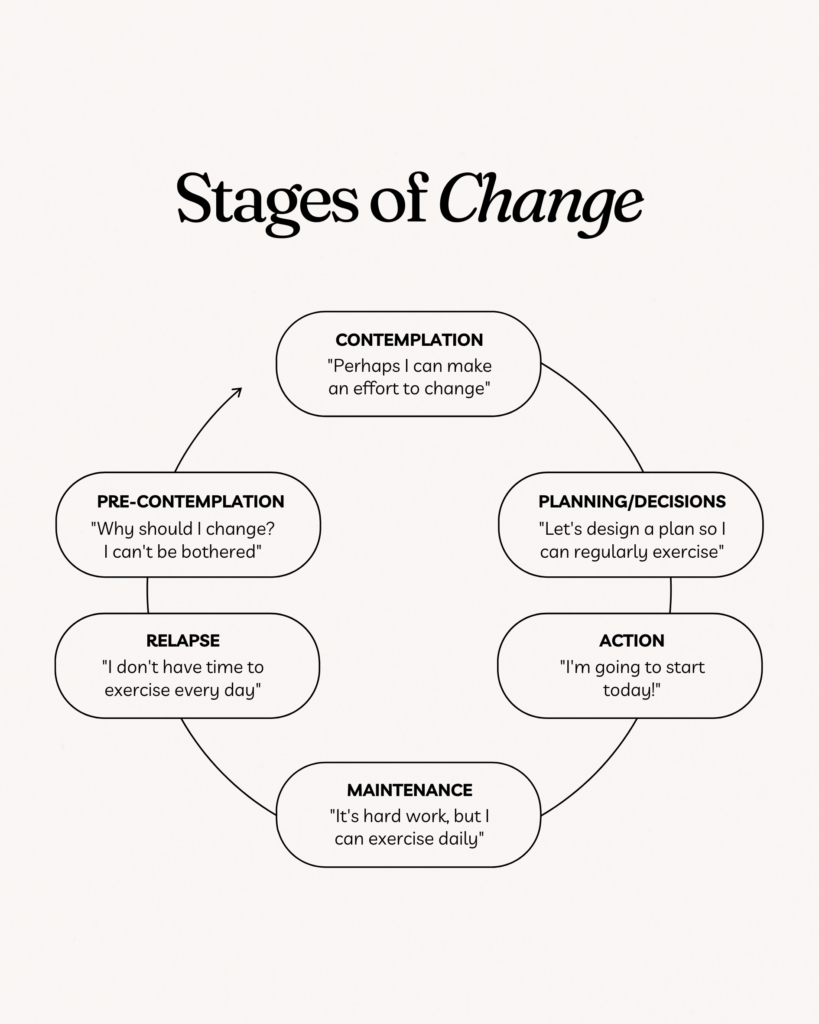
Over time, your perspective may begin to shift. Thoughts come up that you could change something, or maybe even should. This phase is often marked by uncertainty, because the desire for change and the comfort of staying the same exist at the same time.
After that, you often move into a phase where you start engaging with the idea more actively. You think about possible steps, make plans, or begin to make more conscious decisions. And eventually, there comes a point where you actually start taking action.
Why changing habits is so difficult
Many people reach this point and realise that change is harder than expected.
Habits don’t form randomly. They develop over time and become automatic patterns that no longer require much conscious effort. That is exactly why they feel stable and familiar.
When you begin to change your behaviour, you are interfering with this system. Your body and your nervous system tend to respond with resistance before they adapt.
In everyday life, this can show up as a loss of motivation after an initial strong start. Or you may notice that in certain situations, you fall back into old behaviours without really thinking about it.
Not because you’re doing something wrong, but because new habits take time to develop.
Why setbacks are part of the process
One phase that is often underestimated is the return of old patterns. Especially when you’re trying to build new habits, setbacks are almost inevitable.
These moments are often interpreted as personal failure. But in reality, they are a normal part of the process.
Old habits feel familiar and tend to resurface, especially when you are stressed or low on energy. In those moments, it becomes harder to maintain new behaviours.
Setbacks don’t mean that change isn’t working.
They simply show that something is still in progress.
Why you are not back at the beginning
An important point that is often overlooked is that you are not starting from zero.
Even if it feels that way, you are not at the beginning. You have already gained experience, developed a better understanding of certain patterns, and become more aware of your own behaviour.
This awareness doesn’t disappear just because you fall back into old habits for a while.
And this understanding is the foundation for long-term change.
Why change is not linear
If you look more closely at the process, it becomes clear that change is not linear. It moves more in cycles, where progress and setbacks exist side by side.
This shift can feel confusing, because it doesn’t match the idea many people have of personal growth.
Instead of moving forward in a straight line, it can feel like you’re going in circles.
And still, change is happening.
Not always visible from the outside, but often in the way you begin to understand yourself and your behaviour more deeply.
A different perspective on your path
Maybe it’s less about trying to control the process or getting everything right.
And more about understanding it.
Recognising that setbacks, doubts, or phases where your motivation drops are not signs of failure.
But part of what it means to truly change your habits.
Change doesn’t mean doing everything perfectly.
It means finding your way back, again and again.